01
The Season Starts In October
The outdoor season runs roughly from October to April. Many people go from a summer of indoor or reduced training to full mileage within weeks. A jump like that is a common reason for sore calves and shins.


DHA-licensed therapists · Homes and hotels across Dubai
Sports massage is planned around what you train for. The therapist asks about your sport, your week and your next event, then works on the muscles you use most. You do not need to be a competitive athlete to book it.
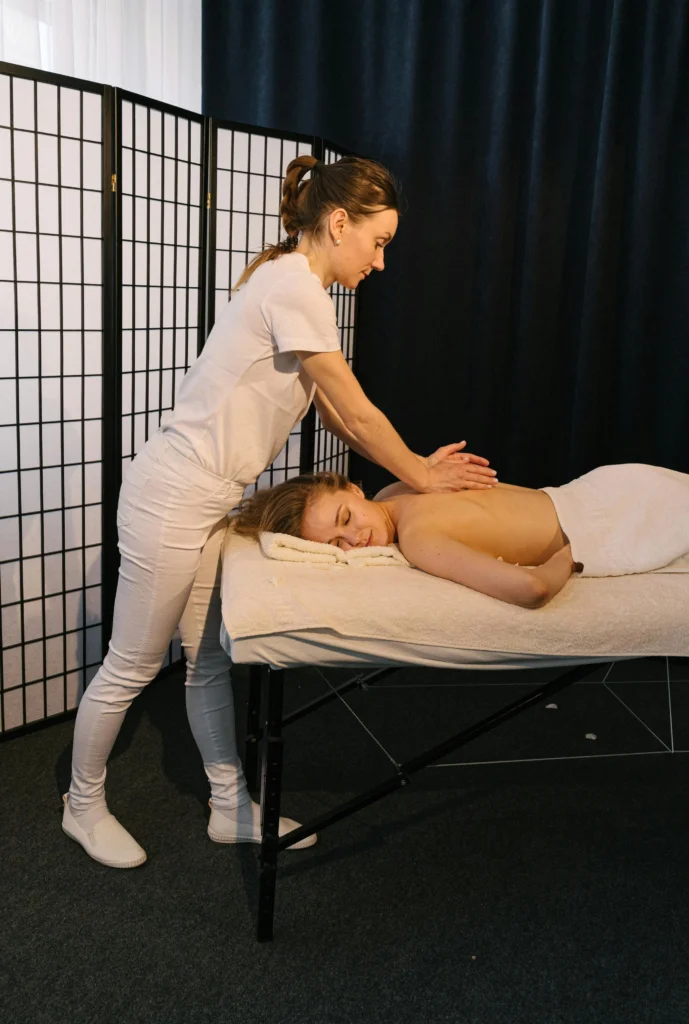
A regular massage
A regular massage follows a full-body routine.
Sports massage
Sports massage starts with questions and then spends most of the time on two or three muscle groups.

Long, firm strokes warm the muscle.
Sustained pressure goes onto tight spots, with friction across the fibres where it is needed.
The therapist also stretches the limb for you while you stay relaxed.
calves, hamstrings, glutes and hips.
quads, hip flexors, lower back and neck.
shoulders, upper back and chest.
whichever muscle groups you loaded that week.
the playing shoulder and forearm, and the calves.
Firm, and at times uncomfortable on a tight spot, but never sharp. Tell the therapist the moment it crosses that line. Mild soreness the next day is normal after firm work.
Timing decides whether a session helps or gets in the way. Use this as a guide.
Your last firm session
Firm pressureDeep work needs a few days to settle
A light, short session, or none
Light or none pressureFirm pressure now can leave the legs heavy on the day
Light work only, a few hours later
Light pressureThe muscles are already inflamed, and deep pressure adds to it
Light to moderate work on the whole area
Light to moderate pressureHelps ease soreness at its peak
Firm work on tight spots again
Firm pressureThe muscle has settled enough to take it
Firm work on the muscles you load most
Firm pressureBest on a rest day or an easy day
After a long run or ride, eat, drink and shower before the therapist arrives. Two to three hours after you finish is a good time to book.

The outdoor season runs roughly from October to April. Many people go from a summer of indoor or reduced training to full mileage within weeks. A jump like that is a common reason for sore calves and shins.
The Dubai Fitness Challenge each autumn, with Dubai Run and Dubai Ride on Sheikh Zayed Road, brings out many first-timers. So does the Dubai Marathon early in the year. If one of these is your first event, follow the timing table above.
Hours on the bike at Al Qudra load the lower back, neck and hands as much as the legs. Say so when you book, so the session is not spent on the legs alone.
In summer a cramp can be about fluid and salt as much as tight muscle. Massage helps ease the soreness a cramp leaves behind. It does not deal with the cause, so drink and replace salts first.
Lactate clears by itself within about an hour of stopping.
A fresh injury needs rest and an assessment first.
A physiotherapist diagnoses and rehabilitates an injury, and we do neither.
Training, sleep and food do that. Massage helps you feel ready to train again.
Do not book a massage for any of these:
One more is an emergency. After extreme effort, especially in heat, dark brown urine with severe muscle pain means going to hospital immediately.
Choose it for long-standing tension that has nothing to do with training, such as a back made stiff by desk work.
Choose it when the problem is stiffness and lost range, not sore muscle. It is stretch-led, clothed and oil-free.
Choose it to switch off. It is also a good option the day before an event, when firm work is a bad idea.
Choose it for swelling and puffiness. It works on fluid under the skin, not on muscle.
| Session | 60 minutes | 90 minutes |
|---|---|---|
| One person | AED 450–650 | AED 550–750 |
| Couples (two therapists) | AED 800–900 | AED 900–1100 |
Sixty minutes is enough for the legs, or for the back and shoulders. Ninety minutes suits a full-body session after a long event or during a heavy training block.
Two people who trained together can be treated at the same time by two therapists at the couples rate. The figure includes travel, the table, oils and linens. We confirm the exact amount before the therapist leaves, and you pay after the session.
Yes, if you train regularly or are sore from exercise. If your tension comes from sitting at a desk, deep tissue is the better choice.
Gentle work helps ease the soreness a cramp leaves behind. Drink and replace salts first. If the calf is swollen, hard or painful the next day, have a doctor look at it.
Not yet. Leave the injured area alone for the first two to three days and have it assessed. Massage comes later, once a doctor or physiotherapist says it is safe.
It depends on how hard you train. In a heavy block, every week or two is reasonable. Otherwise once a month, or around your events, is enough.
No. Sports massage is given by a DHA-licensed massage therapist, who shows the licence at your door if you ask. A physiotherapist treats injuries, and that is a different service.
Shower first if you can, because oil works better on clean skin. The linens are fresh for you, and the table is disinfected between homes.

Message us your sport, what you did and when, the date of your next event, and where you are sore. Add your address.
We reply with the price, and the therapist is usually with you 30 to 40 minutes after you confirm.
We bring sports massage to homes and hotels across Dubai, including Dubai Sports City, Motor City, Al Barsha, Jumeirah and Business Bay.
Book Sports Massage